

FAQ & Interviews
“May my heart sing your praise and not be silent”
Frequently asked questions
We are asked certain questions very often. Here we answer some of them, as they may be of general interest:
How did the idea of starting a sacred music ministry come about?
First of all, we should make clear that developing a project was never a “plan” of ours; rather, we see our apostolate with sacred music as a mission the Lord has entrusted to us on our path of following Christ. We grew up with liturgical chant from childhood, since our parents were members of a spiritual family that places special emphasis on the dignity of the liturgy. When we came of age, each of us independently made the decision to join this spiritual family. Our apostolate as an ensemble began in 2011, as part of a prayer campaign to counter criminal violence in Ecuador. We sang at Holy Masses, during hours of adoration, in sacred music concerts and so on. In this context we discovered the value of sacred music also as a spiritual weapon against the forces of evil, countering the ugliness of sin with the beauty of God. That is how Harpa Dei began.
Why the name “Harpa Dei”?
The name “Harpa Dei” was born in Jerusalem, after we had sung for our spiritual father a Greek Trisagion that we were learning. He was surprised and exclaimed quite spontaneously: “You really are the harp of God!” We fell in love with the expression at once and decided to translate it into Latin and adopt it as our name: the harp of God.
Why do you dress in green?
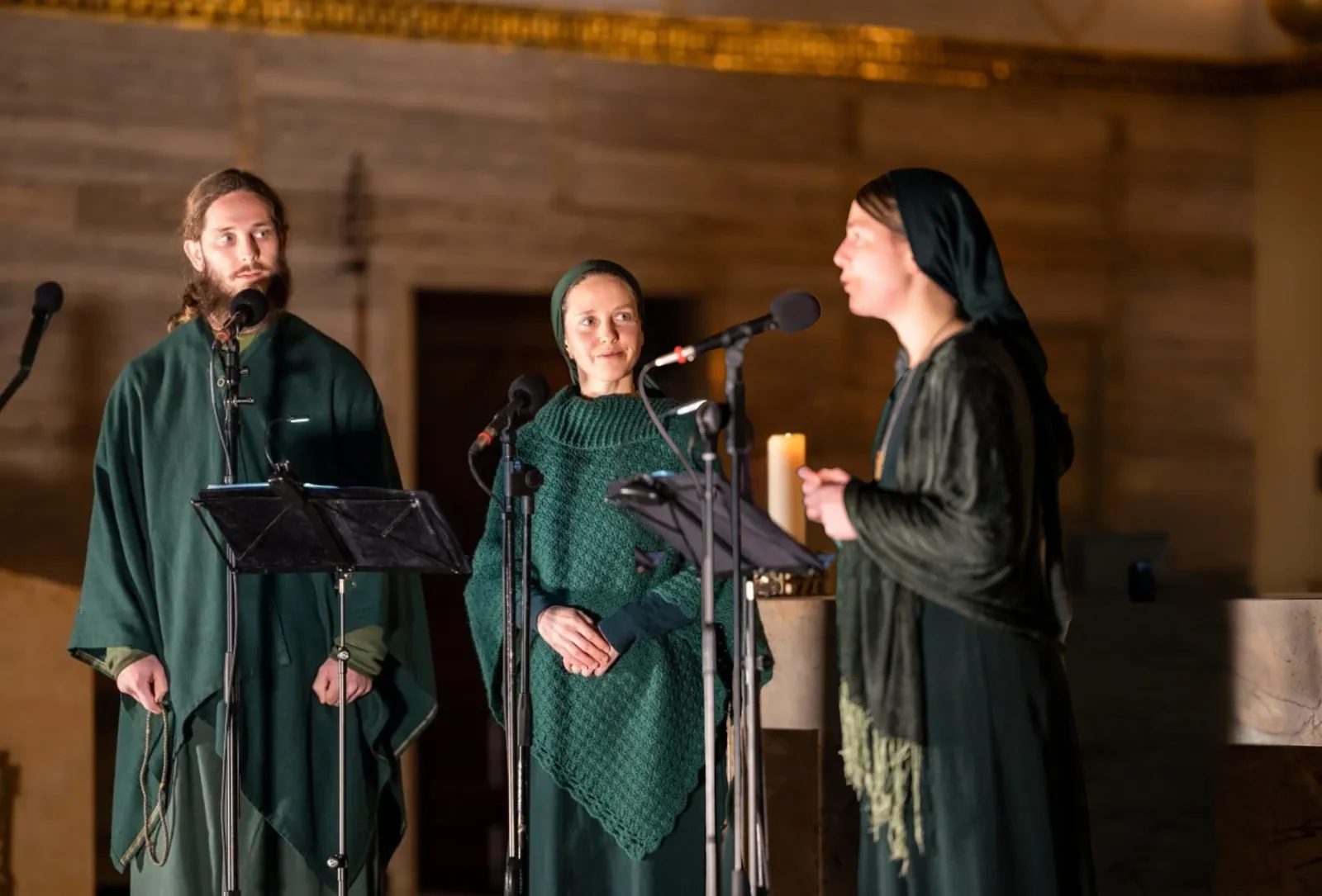
It is the colour of our spiritual family. At first it was not a deliberate decision. But over time we have discovered some very beautiful meanings of the colour green. In the Christian tradition of the East, for example, it is the colour of the Holy Spirit. For this reason, iconography usually depicts the evangelists and the prophets in green robes, since they were especially inspired by the Holy Spirit. St Hildegard of Bingen developed a whole theology around “viriditas” (greenness) and said that the Heart of God the Father was green. This last statement meant a great deal to us, since we have a special devotion to God the Father.
Do you always dress like this?
Yes. It is not simply a “choir uniform”, let alone a costume. Rather, it is a form of dress that underlines the religious character of our life.
How do you choose the pieces for your repertoire?
With some pieces we experience a kind of “love at first sight” or, better said, “love at first hearing”. For example, we first heard the Georgian chant “Shen Khar Venakhi” during a solemn Byzantine liturgy in Russia, and its gentleness was so irresistible that we now leave it out of hardly any of our concerts. We came to know and love a large part of our pieces in Jerusalem, where all peoples gather and where, in a single building (the Church of the Holy Sepulchre), six Christian rites are celebrated, each with a very ancient musical tradition. From the Syriac Christians we learned the Our Father in Aramaic, just as they still sing it in their liturgy today; from the Greeks, the famous Agni Parthene; from the Armenians, the sublime chant of the “Holy, Holy, Holy”, and so on. In this way we try to gather the “musical pearls” of the various peoples.
Since you are siblings, is it hard for you to agree? Do you ever argue about musical or technical matters?
Of course there can be small differences of opinion, but we usually reach a consensus quickly. We try not to impose our personal point of view, but to discover what is right in each situation, what is most pleasing to God. On the whole, we actually see it as a grace that we are siblings both by blood and in spirit, because this has made unity much easier, in our music as well as in our life together.
Where is the fourth sister?
In 2025, our sister Marie-Elisée took some time to discern her personal path. After a year, she told us of her decision to follow Christ as a laywoman in the world. So we now continue our musical mission as three.
How many hours a day do you practise?
Rather than the time we spend strictly practising this or that piece, it is perhaps worth mentioning that sacred music is an essential part of our daily life, which is above all contemplative in focus. Every day we sing the Liturgy of the Hours (Lauds, Vespers and two minor hours) according to the monastic breviary, that is, with Gregorian melodies. In addition, we have the joy of often singing the Traditional Latin Mass, in which Gregorian chant is a constitutive element of the rite. So we could say that we sing for a few hours every day. The time we spend practising varies a great deal depending on the circumstances and the tasks ahead of us.
How do you manage to sing in so many languages?
First of all, we should make clear that we do not speak all the languages we sing in. In most cases, we simply learn the text of the piece. Thank God, we have good friends and acquaintances in various parts of the world who help us and correct our pronunciation in each language. Again and again we experience divine providence in finding the right people.
Do you also listen to other kinds of music, outside the realm of sacred music?
Since we lead a primarily contemplative life, we hardly listen to anything but sacred music (with a few exceptions). Indeed, because sacred music is the highest expression of art and leads to silence, over time the soul no longer looks for anything else. Besides, the diversity within sacred chant is enormous. If we consider only the traditions that can be heard day after day in the Church of the Holy Sepulchre (the place of the Death and Resurrection of Our Lord), we already have plenty of variety: the Armenian, Coptic, Syriac, Greek, Ethiopian and Roman Latin (Gregorian chant) traditions, each with an entirely unique character.
What do you think of so-called “Christian music”?
A basic distinction is needed here: there is “religious music” (such as so-called “Christian music”) and there is sacred music. In the first case, the soul expresses its subjective experience of God. This genre usually has its origins in the Protestant world, which lacks the liturgy as such. Sacred music, on the other hand, is rooted in the liturgical life of the Church. It is therefore objective and ecclesial in character. Here it is God himself who inspires it through the tradition of the Church and invites the soul to take part in the heavenly liturgy and to receive a foretaste of it. While musical tastes change from one age to the next, authentic sacred music has a perennial character.
We like to stress: “Every kind of music in its place.” Within the liturgy, sacred music alone. “Religious music”, on the other hand, can have its place in moments of evangelisation, in prayer groups and so on.
Do you do all the audio and video editing yourselves, or do you have the help of professional technicians?
We do everything ourselves. We have a small home studio where we can record our vocals. Nikolai and Lucia take care of the audio editing. As for the videos, the Lord has spoiled us with the most beautiful landscapes in the places where we live, which lend themselves well to filming. Mirjana works on the video editing. We do have some wonderful collaborators who help us as volunteers, out of love for God; but not a technical team.
Why did you see the need to spread sacred music and love for the liturgy?
Without doubt, the first aim of sacred music is always to glorify God. That is why it has its pre-eminent place within worship, in the liturgy, which is the glorification of God par excellence. We have noticed (and we are certainly not the only ones) that in our Catholic Church the transcendent dimension of the liturgy, in which music plays a very important role, has been lost to a considerable degree. In this sense, one of our great intentions is to make the faithful sensitive once again to the beauty, the sacredness and the transcendence of the liturgy.
At the same time, since sacred music can strike the deepest chords of the soul, we have also experienced it as an effective means of evangelisation, one that can awaken in people a longing for God and lead them to ask themselves existential questions.
What is daily life like for the Harpa Dei siblings?
Our daily schedule varies slightly depending on where we are. But here we will focus on what a day looks like when we are in Jerusalem (which is our “spiritual home”): we get up early in the morning, between 3:00 and 3:30, and when the doors of the Church of the Holy Sepulchre open at 4:00 we are always there for our morning prayer. We begin with an hour and a half of silent personal prayer at Calvary, then we sing Lauds and have half an hour of spiritual reading. After breakfast we have time for work, both for the ordinary chores of everyday life and for the various tasks connected with the apostolate (daily meditations, music recordings, correspondence and so on). At midday we have lunch, followed by an hour’s siesta. Then comes another hour of personal prayer (the Holy Rosary, praying None and so on). After that we have another period of work until dinner, and the day ends with a final hour of community prayer, which includes Vespers and Compline. Whenever we have the opportunity, we attend the Traditional Latin Mass; the time varies. We usually go to bed early so that we can get up early again the next day.
When we are away on mission, we try to keep our rhythm of prayer as far as possible, but we adapt to the circumstances that the apostolate brings with it.
Interviews
Over the years Harpa Dei has been invited to speak about its music, its life of prayer and its mission. Here are some of those conversations: